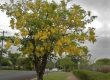
SITA ASHOKA – SORROW-LESS TREE
As a child I had the privilege of spending a lot of my time with my grandparents. Grandparents by way of their practices and habits have great influence on us. Children learn not by what is told to them, but more by what they observe around them. My grandparents, like most other Grandparents were Pious, God fearing and loving. During the summer holidays we started our day by going for a walk in the garden, where we would play, feed the cows, pigeons, birds, ants and at night listen to bed time stories about God and sing bhajan’s in praise of The Lord. And of course listening to Ramayana and Mahabharata stories was a favourite.
And, during the Dussehra holidays we went to see Ramleela in Ramleela maidan and enjoyed the burning of Ravana. While my Nani narrated Ramayana stories, there was often a mention of Ashoka vatika where Hanumanji meets Godess sita as he goes in search of her. The name of the Ashoka tree somehow got registered in my mind at the time. I was told that Ashoka meant Sorrow-less and I knew that if I ever got the chance I would certainly plant this tree in my garden.
In Delhi you can see lots of tall Ashoka trees, some of them shaped like an umbrella. So when I shifted to my new place in Mumbai I thought of planting them as a border in my small garden and I went and bought around 3-4 Ashoka trees to plant. But as the trees starting growing tall I found that the grass under the tree was not growing well and then I was told that it is the shade of the tree which is not allowing the grass to grow well. This was something new for me. The reason we plant trees is that they provide shade and we presume that the shade is good, but then the we do not realize that the same shade can be hinderance to other small plants and grass beneath or besides it. And if you go deeper, the same rule applies to life too. Too much of protection(shade) in any form, whether in relationships, society or country is not good. It hampers growth and does not allow the true potential to be reached. So going ahead with this rule I decided that I need to create space between my Ashokas for them to grow along with the other plants and allow the grass to spread as well. I shifted some to pots and gifted the rest.
Being a nature lover I like to see various gardens around, so one day I visited one of my friends garden in the same locality and saw a beautiful tree with deep green leaves covered fully with orange and yellow flower bunches all over. The leaves had a slight resemblance to the Ashoka tree I had. When I asked her the name of the tree I was told that it is called The Sita Ashoka. And it is then that I realized that the tree that I had planted in my garden was not an actual Ashoka tree, but is mast Ashoka or false Ashoka. It is called false Ashoka because of growth resemblance to Sita Ashoka tree.
Although both the trees have Ashoka as their second name, the trees are very different in terms of their leaves, flowers, seeds and height. Most of us however are not aware of this fact. What we see being planted around is actually false Ashoka and not Sita Ashoka. Sita Ashoka is the actual Ashoka tree of Ashoka Vatika as mentioned in the Ramayana. The Sita Ashoka is a beautiful branched tree. It bears fragrant flower bunches.The colour of these small flowers is a striking yellow and orange. It’s flowering season is from February to April. It attracts lots of bees, butterflies and birds.
It is very sad to note that the tree which is so sacred and divine, not only to Hindu’s but also to Jains and Buddhists, is becoming rare in its natural habitat. It not only finds mention in Ramayana, but it is also said that Buddha was born under The Ashoka Tree.
This tree is a boon to women. Its bark, seeds and flowers are used for various gynecological problems. Apart from its dried flowers, it’s seed powder and tree ash are also used for treating diabetics, dysentery, kidney stones, joint pains etc and is also used as a memory enhancer.
So I decided that I would distribute its sapling and seeds to my friends and people around. Fortunately it propagates very easily from its seeds which fall on the ground. While False Ashoka which is native to India too has its benefits, it is planted due to its effectiveness in alleviating noise. We also use its leaves in religious ceremony as decoration. It is used for landscaping. Its Fruit are borne in clusters of 10-20. The fruits are initially green but turn purple or black when ripe. These are loved by birds. The tree can be propagated by seeds or cuttings. It is a drought-tolerant, medicinal tree.
But its important that we give Sita Ashoka its well deserved place and not let it disappear from mother earth. So come friends lets plant this tree in common garden, footpaths or any empty space and lets create a Sorrow-less world if not Sorrow-free.
Picture source: http://cfile216.uf.daum.net