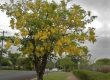
Here we go around the mulberry bush, the mulberry bush – was my favourite nursery rhyme and I used to enjoy reciting and enacting it as a child. But, at the time I had no idea what a mulberry bush looked like. Although times have changed and we try to integrate learning with practical demos, even today if the same poetry continues to be recited in schools many of the children wouldn’t get to see a mulberry bush or recognize one.
One of the reasons for this could be that the fruit rarely makes its way into the markets due to its highly perishable nature. Which is not the case with blueberries or strawberries which are easily available in the market during their harvest season. But looking at a broader and more holistic perspective, while we are moving towards a more advance and scientific world, we are also moving away from nature. During my childhood, nature was all around us and we used to play in natural surroundings. Today we have man-made models created to experience the natural world. We have developed artificial lakes, ponds and zoos to satisfy our learning quest.
When I shifted to my new place, I knew that I had to plant a mulberry bush, not only to refresh my childhood memories, but also because a person’s best chance of eating mulberries in India is either by finding a wild bush, by living near a silkworm farm, as mulberry leaves are used as food for silk worms, or by growing one at home. And the last option appeared to be the best one, so I started searching for a mulberry tree sapling and found one in a plant exhibition. It was a small sapling; I was told that I could grow it in a pot.
Certain Important facts about Mulberry trees that I came to know through my gardening journey is that – Mulberry is a deciduous, fruit-bearing tree and goes by the Latin name Morus, derived from the Moraceae family. It includes many species with the most popular ones being Morus alba, Morus nigra, and Morus rubra. In lay man’s terms, the most commonly known species are the white, black, red and hybrid variety. Their names are derived from the colour of the buds and not the fruits. Each of these species vary in terms of the size they grow into, their longevity, their leaf shape, fruit taste, etc.
But all the mulberries go through the same ripening stage, i.e. from white to green and then pink to red and then purple black finally. The adage for most mulberry varieties is, “the darker, the better.” The sweetest mulberries tend to be rich purple; almost black. One should pluck mulberry only when ripe as they do not ripe after being plucked as may be the case with some other fruits. If you look at a mulberry fruit it is an aggregation of small fruits arranged together. Some people also confuse it with raspberry.
Mulberry trees are native to the warm regions of Asia, Africa and the America, with most of the species native to Asia. They prefer full sun and rich soil but can also tolerate part shade and a variety of soils. They are easy to transplant, salt tolerant, are great for erosion control and make wonderful windbreaks. The most outstanding thing about the Mulberry tree is that they require minimal care and are usually free of pests and diseases. Mulberries can be grown from seeds, and this is the best way as seedling-grown trees are generally healthier. However, they are most often planted from large pieces cut from other Mulberry trees, which take root easily.
We need to prune mulberry to maintain it as bush. It is best to avoid pruning heavily as mulberries are prone to bleeding at the cuts. Avoid cuts larger than 2 inches, as they will not heal. If you prune when the tree is dormant, bleeding will be less severe. Pruning is only to remove dead or overcrowded branches. It is also best to plant this tree during the rainy season.
The tree attracts lots of birds and squirrels. In fact birds prefer them to other berries and cherries, hence many times they may be planted before other tree to safeguard their fruit. But of course if you want to eat mulberries you track and tap them before they fall prey to the other creatures.
Mulberry season occurs twice a year the first from October through November, and the second occurring March through May. Mulberries are loaded with health benefits on account of its deep purple hue. Dark-skinned fruits—like cherries, pomegranates, grapes, and blueberries—have cancer-fighting polyphenols. Mulberries are no exception.Traditionally, Ayurvedic practitioners have used mulberry leaves as an emollient and diaphoretic, and have used the fruits to treat depression and fever. To combat sore throats, some gargle a brew made from the leaves. In fact I learnt that Mulberry tree leaves tea is very popular. Many of the fruit benefits are also mentioned in the book, “Invasive Plant Medicine”.
Mulberry is known as Kalpa Vruksha in India. When my tree started fruiting after 4 years of planting it, I gave the fruits to my father to eat. He told me that it is called Shahtoot in hindi. Shahtoot is a name from farsi and means “kind mulberry”. The Mulberry is called Tooti in Marathi. There is a Pakistani mulberry tree, Persian mulberry tree and there is difference in the two in terms of size, taste etc.
Something which annoys most of us is the purple colour which the fruit leaves when it falls on the ground or on our hand and clothes while eating. But, I was also given solution for the same by my father. I was told by him that we can rub the leaves of the mulberry tree on our hands or where the stain is and wash. The strain will easily fade away. I tried it and it worked. So you see, nature provides solutions to the so called problems created by it, unlike us human beings who search outwardly for solutions.
I read somewhere that In Punjab there used to be a cottage industry built around the Shahtoot trees which used to grow near village wells and in fields. Not only were they good for shade in hot summers but the villagers also wove baskets from the tree bark. But now they are a rare sight in Punjab. Its important that the government gives help and guidance to villagers who I am sure would willingly farm silkworms and make silk for the textile industry if only they knew how to go about it.
I recently spotted three big Mulberry trees in my adjoining colony full of this delicious fruit, with no one plucking them. I had to bring it to their notice that it is a super fruit and is edible. It’s sad that most of us are not aware of the trees which grow in our surroundings or their benefits. Hence, I decided that I need to write this article so that as nature lovers not only will we plant this tree, but also spread whatever little useful knowledge we have about this tree so that we can all enjoy these priceless berries.
So come forward and put this plant in your wish list as its not only an easy to grow fruit tree but it will also reward you with bountiful crops of fresh fruit which is a super fruit as it has the highest level of antioxidants compared to any other red berry fruits, plus boasts an impressive nutritional CV outperforming cranberries, blueberries, blackberries and raspberries.
A word of caution: while the leaves, fruit and bark of the Mulberry tree have all been used for medicinal purposes, the leaves and unripe berries may have slight hallucinogenic properties. Some people report that they have allergies to the mulberry pollen and/or to the berries.
.


Picture source: http://plantplots.com, http://4.bp.blogspot.com