
India is a country with myriad religion, culture and their influences. Because India has so many diversified influences, it stands out in terms of historicism, arts, culture and heritage. Every state has something unique to offer in the department of arts & culture and one such art offering is “Kalamkari” which in its name itself offers us its description. Kalam meaning “pen” and Kari meaning “work “ which literally means art work done using a pen.
This art goes ages back to the ages when the Mughals had invaded India. Today it is popular in many regions of India but is mainly the most popular or rather we can say is produced in massive no’s in Kalahasti and in Masulipatnam in South India. The traditional Kalamkari designs mainly consist of scenes from Hindu mythology. Figures of deities with rich border embellishments were created for the temples and vegetable dyes were used to colour the designs applied on the cloth.
In Masulipatnam the weavers were involved in the block printing art. But it’s just not just the figures of the deities that became popular but owing to the various diverse habitants of our country at various times, like the Muslim rule in Golconda in Hyderabad, we saw the Masulipatnam Kalamkari heavily influenced by the Persian Motifs & Designs to suit the then rulers. When the English came they brought in their own trend which saw the designs and the fabrics being used differently. During the British rule “floral” designs were very popular for garments as well as furnishings.
The English also made the artisans create potraits of the nobels. During the Maratha rule, “Karrupur” which is another customized style of Kalamkari developed in the Thanjavur region of Mahrashtra. Hence we can see many diverse influences, spread across time and space, contributed to the evolution of the Kalamkari in India.
Interestingly the Kalam (pen) that was used was a bamboo or date palm stick pointed at one end. A bundle of fine hair attached to this pointed end served as the brush or pen for the finer details and finesse while the outline and main features were done using hand carved blocks. Only natural dyes are used in Kalamkari which are obtained by extracting colors from parts of plants – roots, leaves and from mineral salts like iron, tin, copper, alum, etc.
The process used in Kalamkari work involves seventeen painstaking steps like the fabric (usually cotton) is whitened in a solution of cow or goat milk and dried in the sun for a couple of days. Then comes the drawing of the motifs with the bamboo Kalam, which is soaked in a mixture of fermented jaggery and water. Once the drawing is done, the dyes follow which as mentioned before are obtained from various part of plants. Sometimes certain colors require the application of alum and wax. Once the applying is done the Kalamkari undergoes many washing (sometimes 10 or more) before completion. Lastly for various effects artisans also use cow dung, seeds and crushed flowers.
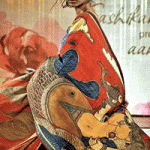
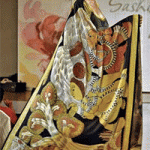
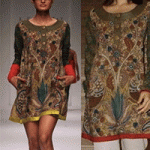
The whole process requires detailed attention and sometimes gets very tedious. Kalamkari work requires lot of hardwork, handwork and patience. With modern machinery’s making their way into the textile world, there was a certain lull seen in the creating of this unique art but with time it was once again revived in India. The art was applauded and gained recognition both in India and abroad for its craftsmanship. Even today we can see the art being practiced by many families in Andhra Pradesh. Some families have been into this art from generations and it is their means of livelihood. Kalamkari products have started to get popular due to its organic and natural approach in making. One can find kalamkari work on paintings, bed sheets, various clothing like pants, sarees, salwar-suits, jackets, skirts, drapes like dupattas and accessories like purse, footwear etc.
There are many loyalists of this art who have forever been buying it and can’t get enough of Kalamkari and some very famous dress designers have had fashion shows or a complete line dedicated to this form of art. The very recent shown was done by Hyderabad based fashion designer Shilpa Reddy where she showcased some of the very beautiful kalamkari work in Paris fashion show2014. Also watch youtube video on Kalamkari art.
-

- 4
-
- 1
-
- 2
-
- 3
Watch youtube video on Kalamkari art